
By ToolNexus Team
Every packaged item you have bought carried one. Almost nobody knows what the stripes mean. So what is a barcode? It is a number written in a way a machine can read faster and more reliably than a person can type it. That single property changed how retail works.
Quick Answer at a Glance
| Question | Short answer |
|---|---|
| What it stores | Usually a number, sometimes short text |
| What it does not store | Prices. Those live in the shop’s database |
| How it is read | A scanner measures the width of the bars and gaps |
| Main retail types | UPC in North America, EAN elsewhere |
| Dimensions | One, read across a single line |
| Replaced by QR codes | No. The two do different jobs |
How the Stripes Actually Work
The information is in the widths rather than in the bars themselves.A scanner shines light across the code and measures how long each dark and light region lasts. Those widths follow a defined pattern where certain combinations mean certain digits. Reading the pattern gives the number. That number is then looked up in a database to find the product, the price and the stock level.That last point surprises people. A barcode contains no price. Change what you charge for something and no label needs reprinting, because the price was never in the code. That separation is precisely why the system scaled.
The Types You Will Actually Meet
| Type | Where you see it | What it holds |
|---|---|---|
| UPC-A | North American retail | 12 digits identifying a product |
| EAN-13 | Retail outside North America | 13 digits, with a country prefix |
| Code 128 | Shipping, logistics, warehouses | Letters and numbers, variable length |
| ITF-14 | Outer cases and cartons | 14 digits, printed on corrugated board |
| Code 39 | Older industrial and military systems | Letters and numbers, less compact |
UPC and EAN are the two most people encounter. They are close relatives, which is why a European product usually scans without complaint at an American till.
Where the Number Comes From
Retail barcode numbers are not invented by the manufacturer. They are issued.A global organization allocates company prefixes. Each business assigns product numbers within its own prefix. That is what keeps the numbers unique worldwide. It is also why a genuine retail barcode costs money to obtain while an internal warehouse label costs nothing. A shop tracking its own stock can print whatever numbers it likes, since nobody outside the building needs to interpret them.
Barcode or QR Code
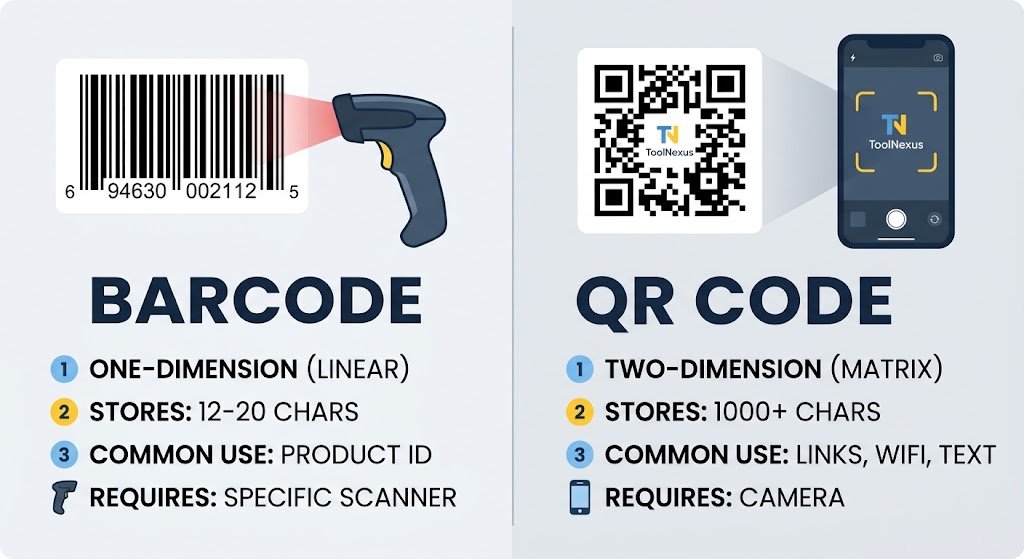
They coexist because they solve different problems.
| Comparison | Barcode | QR code |
|---|---|---|
| Dimensions | One | Two |
| Capacity | Around 12 to 20 characters | Thousands of characters |
| Damage tolerance | Poor. A scratch across it fails | Good. Error correction rebuilds it |
| Reading angle | Needs a straight-on line | Reads at any rotation |
| Typical use | Product identification at a till | Links, Wi-Fi, contacts, menus |
A supermarket does not need a QR code to identify a tin of beans. Twelve digits does the job, prints tiny and scans in milliseconds with cheap hardware. The barcode survives because it is sufficient, which is usually the reason old technology survives.
Why They Fail to Scan
Four causes cover nearly all of it.
- Damage across the bars. A single scratch running the wrong way breaks the pattern.
- Poor contrast. Faded printing or a colored background confuses the reader.
- Curvature. A label wrapped tightly around a bottle distorts the widths.
- Missing quiet zone. Barcodes need clear space at both ends and printing too close to the edge removes it.
Reading One Yourself
The ToolNexus tool that will scan qr code from image has a barcode mode as well. Upload a photograph of the label and the number is decoded and displayed, which is useful for checking a code you have printed or reading one from a picture somebody sent you.For scanning with a phone camera in a shop or a warehouse, the practical method is in how to scan a barcode with phone.
A Note on Trust
A barcode carries a number and cannot send you anywhere, which makes it harmless in a way QR codes are not. If a label on a package carries a QR code rather than a barcode, the caution described in are qr codes safe applies.
About the Author
The ToolNexus Team builds free browser based file tools. The site started with a small group of developers who thought professional grade utilities should not carry a professional grade price tag. It now runs ten tools covering images, PDFs, video and code.
FAQs About what is a barcode
What is the difference between a barcode and a QR code?
A barcode stores data in one dimension, read across a single line. It holds around twelve to twenty characters. A QR code stores data in two dimensions and holds thousands, with error correction that survives damage. Barcodes identify products cheaply. QR codes carry links, credentials and text. Neither replaced the other because their jobs barely overlap.
Is a QR code considered a barcode?
Technically yes. A QR code is a two dimensional barcode. The broader term covers both. In everyday use barcode means the striped one dimensional kind and QR code means the square. The formal distinction matters mainly when buying scanning hardware, since older equipment often reads only the linear types.
Can I create my own barcode?
For internal use, easily and free. Generate any number, print it, then read it back with your own system. For retail it is different. Selling through shops needs a number issued through the global registration system, which costs money and guarantees the code is unique worldwide. Inventing one risks colliding with a real product.
Why are barcodes needed?
Speed and accuracy. A person typing a twelve digit number makes mistakes and takes several seconds. A scanner reads it correctly in milliseconds. Multiply that across every item in every shop and the saving is enormous. The accuracy matters more than the speed, since a mistyped product code corrupts stock records rather than merely slowing a queue.
What’s the difference between QR and barcode?
Capacity and resilience. A QR code holds far more data and keeps working when part of it is damaged or covered, because of built in error correction. A barcode holds a short number and fails if a scratch crosses the bars. The barcode wins on cost and print size, which is why tills still use them.
A Number, Written for Machines
That is all a barcode is. The stripes encode digits. The digits identify a product. Everything else lives in a database. Decode any barcode from a photograph free on ToolNexus with no account.
Comments (2)
2 totalNo comments yet. Be the first to share your thoughts!