
By ToolNexus Team
One of these keeps working forever and can never be changed. The other can be edited any time and stops working the day you stop paying. The dynamic vs static qr code choice is really a question about whether your code is printed on something permanent. It catches out more small businesses than any other decision in this area.
Quick Answer at a Glance
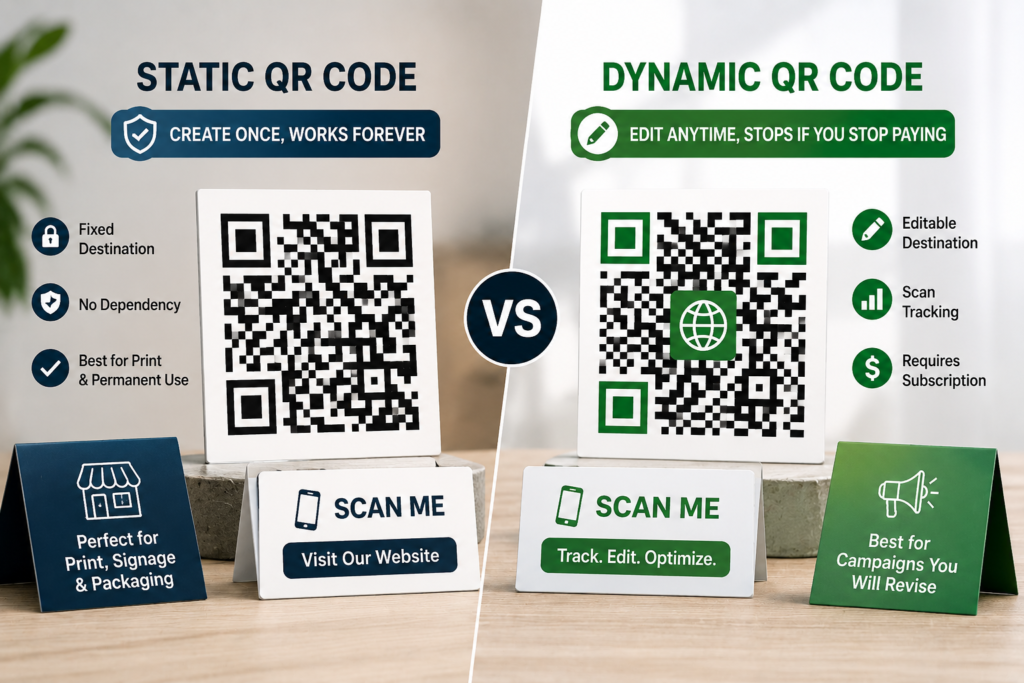
| Comparison | Static | Dynamic |
|---|---|---|
| Destination stored | Inside the pattern | On a third party server |
| Editable after printing | No | Yes |
| Scan tracking | No | Yes |
| Ongoing cost | None | Usually a subscription |
| Stops working if | The destination page closes | The subscription ends |
| Best for | Print, signage, packaging | Campaigns you will revise |
The Mechanical Difference
A static code carries the destination inside the pattern. The scanner reads the address directly and goes there. Nothing sits in between.
A dynamic code carries a short address belonging to a redirect service. The scanner goes there first, then the service forwards it to wherever you have currently pointed it. That extra hop is what allows editing and counting. It is also the dependency that makes the code fragile.
What You Are Actually Buying
Two things. Only two.
- Editability. Change the destination without reprinting anything.
- Analytics. Count scans, see rough locations, see times of day.
Everything else marketed alongside those is packaging. If neither of those two matters to your use, a dynamic code offers nothing and costs money.
The Trap Nobody Reads About Beforehand
A dynamic code belongs to the service that issued it, not to you.Stop paying and the redirect stops resolving. Every printed code carrying that address becomes dead paper. Menus, signage, packaging, business cards, vehicle livery. All of it, at once, because of a lapsed card on a subscription somebody set up two years ago and forgot.This is not a hypothetical. It is the single most common QR failure a small business hits. The cost lands entirely on the reprinting rather than on the subscription.
When Dynamic Genuinely Earns Its Cost

Three situations make it worthwhile.A campaign that changes. If the same poster needs to point at a different landing page each month, reprinting costs far more than the subscription. A campaign you need to measure. If the budget depends on proving scan numbers to somebody, you need the analytics. And packaging with a long shelf life, where the product page will move before the boxes run out.Outside those, static is the safer default for anything going to print.
How to Get Editability Without the Subscription

This is the part the paid services would rather you did not work out.Point a static code at a page on your own domain, then redirect that page whenever you need to. You control the domain. The code keeps working as long as your website exists. You can change where it leads any time you like. You lose the scan analytics, though your own site statistics will show visits to that page, which is usually close enough.A static code pointing at yoursite.com/menu is permanent, free and editable. That covers the majority of small business cases without any third party involved.
What Static Costs You
Honesty runs both ways. Static has a real weakness.If the destination disappears, the code is dead and cannot be repointed. A link to a social profile you later rename, a shortened link from a service that closes, a page on a platform you leave. All of those break a static code permanently. Pointing at your own domain is what removes that risk, which is why the advice above matters more than the format choice itself.
Making One
The ToolNexus custom qr code generator produces static codes for links, text, contacts, Wi-Fi and email. They never expire and there is no account, which suits printed material. It does not produce dynamic codes. If you need tracking you will need a paid service.Whichever you print, check it afterwards. The tool that will scan qr code from image confirms the destination. The article are qr codes safe covers why that check matters on anything public.
About the Author
The ToolNexus Team builds free browser based file tools. The site started with a small group of developers who thought professional grade utilities should not carry a professional grade price tag. It now runs ten tools covering images, PDFs, video and code.
FAQs About dynamic vs static qr code
How does a QR code work step by step?
A camera locates the three large squares at the corners, which tell it where the code begins and how it is rotated. It then reads the pattern of dark and light modules as binary data and decodes that into text. Built in error correction repairs damaged sections, which is why a scuffed code on a receipt still reads correctly.
What are the disadvantages of using QR codes?
A reader cannot see where a code leads before committing, which is what makes tampering effective. Codes need a working camera and usually a data connection. They fail when printed too small or with weak contrast. And a static code cannot be redirected after printing, while a dynamic one stops working if its subscription lapses.
Can a QR code be changed after printing?
Only if it is dynamic. Even then it works only while the service issuing it is still paid for. A static code is fixed the moment it is generated. The practical workaround is to point a static code at a page on your own domain and redirect that page instead, which gives you editability without an ongoing cost or an outside dependency.
Pick by What You Are Printing
Permanent material takes a static code pointed at your own domain. Campaigns that change or need measuring take a dynamic one, with the subscription treated as a running cost rather than a one off. Generate a free static code on ToolNexus in about ten seconds.
Comments (2)
2 totalNo comments yet. Be the first to share your thoughts!